Showing posts with label Gary McKinnon. Show all posts


McKinnon, who has admitted breaking the law and intentionally gaining unauthorized access to computer systems, wants to be tried in Britain rather than the United States. He is asking judges at the High Court to review a decision by the director of public prosecutions not to pursue legal action in Britain, a spokeswoman at the prosecutor’s office told CNN. The prosecutor’s decision effectively cleared the way for McKinnon’s extradition, and McKinnon is hoping it will be overturned. It is not clear when the judges will make a decision on McKinnon’s request. Prosecutors made their decision in February despite saying there was sufficient evidence to prosecute McKinnon. But they said their evidence did not reflect the level of criminality alleged by U.S. authorities, so they would allow him to be tried in America. The U.S. government says McKinnon carried out the biggest military computer hacking of all time, accessing 97 computers from his home in London for a year starting in March 2001 and costing the government about $1 million. McKinnon, currently free on bail in England, has said he was simply doing research to find out whether the U.S. government was covering up the existence of UFOs. Prosecutors in the United States and Britain disagree. (via UK Pentagon hacker fights extradition to U.S. - CNN.com)

British hacker fights extradition

from BBC NEWS:
British hacker fights extradition
Last Updated: Wednesday, 14 February 2007, 12:33 GMT

A Scot has launched a High Court fight against extradition to the US for allegedly carrying out the "biggest military computer hack of all time".

Glasgow-born Gary McKinnon, 41, is accused of gaining access to 97 US military and Nasa computers.

Home Secretary John Reid granted the US request to extradite him for trial.

At the High Court in London, his lawyers argued he had been subjected to "improper threats" and the move would breach his human rights.

Edmund Lawson QC, told two judges that, if extradited, Mr McKinnon would face the prospect of an unknown length of time in pre-trial detention, with no likelihood of bail.

Made threats

If found guilty, he would then face a very long prison sentence "in the region of 45 years, if not more", said Mr Lawson.

There was also the prospect that he would not be allowed to be repatriated to serve part of that sentence at home in the UK.

Mr Lawson said the US authorities had made threats during the plea bargaining attempt in 2003 which infringed his family and private life rights under Article Eight of the European Convention on Human Rights.

Mr McKinnon has never denied that he accessed the computer networks of a wide number of US military institutions between February 2001 and March 2002. He was arrested in November 2002.

He has always maintained that he was motivated by curiosity and that he only managed to get into the networks because of lax security.

The hearing continues.

(BBC NEWS http://news.bbc.co.uk/2/hi/uk_news/scotland/glasgow_and_west/6360917.stm)

McKinnon supporters to 'fight on'

McKinnon supporters to 'fight on'
Last Updated: Wednesday, 10 May 2006, 16:06 GMT 17:06 UK

By Mark Ward

Technology Correspondent, BBC News website

Supporters of Gary McKinnon have vowed to continue fighting to stop the hacker being extradited to the US.

In a hearing on Wednesday a judge recommended he be extradited where he will face trial for breaking into government networks.

Friends and supporters of Mr McKinnon fear that he will not get a fair trial if he does end up in America.

The final decision on whether he will be extradited will be made by the home secretary.

Appeal planned

A friend of Mr McKinnon who runs the "Free Gary" blog publicising the case said the decision by the judge was not "proper justice".

He added that the vast majority of people visiting the blog to comment on the case thought Mr McKinnon had been treated harshly and was facing punishment that did not fit his crimes.

If the harshest sentence is served on Mr McKinnon he could face up to 70 years in jail.

Dr K, another hacker watching the case, told the BBC News website: "We have to increase the campaign to ensure that Gary McKinnon is tried in the UK - for that reason the home secretary's decision is crucial."

Mr McKinnon has been charged with breaking in to a series of US military and government computer networks between February 2001 and March 2002.

The US alleges that during his hacking spree he caused $700,000 (£375,235) of damage. One network he damaged took more than a month to repair, says the US.

"If he really wanted to damage the US military he had ample opportunity to do that," said the editor of the Free Gary blog, pointing out that Mr McKinnon had access to the networks for a long time before he was caught.

However, said the blog co-ordinator, none of this evidence had been presented to a British court to scrutinise. Instead UK courts considering Mr McKinnon's case have been debating the legality of the US extradition request.

"All the legal arguments have been about whether the request is in the proper form," he said.

Extradition issue

A decision was due in February 2006 but was delayed while the courts considered assurances from the US that Mr McKinnon will not be tried by a military tribunal, will be eligible for parole and will not have to serve his sentence at Guantanamo Bay.

District Judge Nicholas Evans, who ruled in the case, said he had received assurances that Mr McKinnon would be tried in a federal court in Virginia.

Receiving this guarantee meant, Judge Evans said, that "any real - as opposed to fanciful - risk" of Mr McKinnon being sent to Guantanamo had receded.

Home Secretary John Reid now has three months to decide whether to approve the extradition request.

Two other related cases also involve extradition and the decisions in these could be a strong indicator of how the request to extradite Mr McKinnon will be handled.

Karen Todner, Mr McKinnon's solicitor, said: "We're proposing to appeal this to the Secretary of State, and if we're still refused we will then appeal to the High Court for a decision to allow Gary to be tried here as a British citizen.
[link]
[Free Gary Blog]

UK hacker 'should be extradited' - BBC News

UK hacker 'should be extradited'
Wednesday, 10 May 2006, 12:06 GMT 13:06 UK

UK hacker Gary McKinnon should be recommended for extradition to the US, a district judge has ruled.

The decision means Mr McKinnon will face trial in America for what the US has called "the biggest military hack of all time".

Although he has admitted hacking US military networks, Mr McKinnon said he was motivated by curiosity not malice.

The final decision on whether he should be sent to the US for trial rests with the home secretary.

Hack attack

The decision was given at Bow Street Magistrates' Court in London and ends three years of uncertainty for Mr McKinnon.

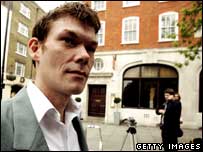
Speaking outside the court after hearing the decision Mr McKinnon said: "It went as expected and now the appeals process can now start."

Karen Todner, Mr McKinnon's solicitor, said: "We're obviously very disappointed with the judgement that was given this morning. We're proposing to appeal this to the Secretary of State, and if we're still refused we will then appeal to the High Court for a decision to allow Gary to be tried here as a British citizen."

Mr McKinnon was first arrested in 2002 by the UK's National Hi-Tech Crime Unit for hacking into a series of computer networks used by the US Army, Navy, Air Force, and Department of Defense.

The US in its case for extradition said Mr McKinnon caused more than $700,000 (£375,235) of damage while exploring the computer networks at various US military institutions.

[link via New Scientist Technology Blog]